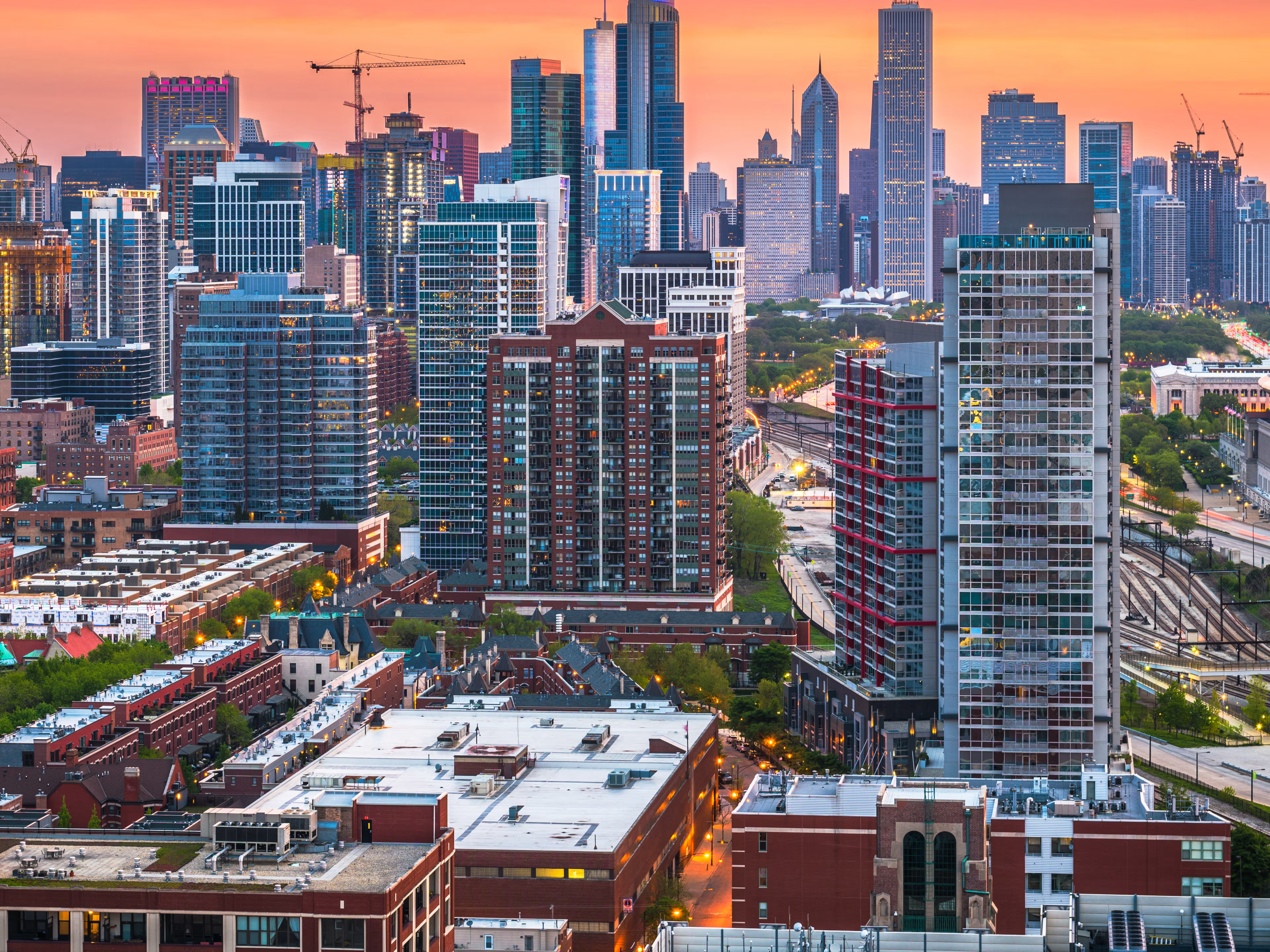
Chicago's nine downtown neighborhoods are all within about three miles of each other. The rents are different, the energy is different, and the renters who thrive in each are often completely different people. This guide covers what it's actually like to live in each one — not just what it costs, but what your daily life looks like from the inside.
If you already know which neighborhood you're considering, jump directly to that guide below. If you're still figuring it out, start with the two questions that resolve most searches: where do you work, and what do you want your neighborhood to feel like after hours.
See available apartments across all nine neighborhoods →
What It Costs to Live Downtown in Chicago
Downtown Chicago one-bedrooms range from $2,100 in South Loop to $3,057 and above in River North, per Yardi Matrix data from 2025–2026. The citywide average rent hit $2,454/month in early 2026, up 4.64% year-over-year according to Yardi Matrix, with Chicago leading all major U.S. markets in rent growth through 2025 per CBRE's 2026 market outlook. Chicago's multifamily pipeline is at its lowest construction level since the Great Financial Crisis — which is keeping rents climbing in core downtown neighborhoods.
The meaningful differences between neighborhoods aren't just about price. A one-bedroom in South Loop at $2,100/month and a one-bedroom in River North at $3,100/month are not the same trade-off — the geography, the commute, the building age, and the street-level experience are all different. Read the neighborhood guides below before deciding purely on price.
River North
River North is Chicago's most social downtown neighborhood — the highest bar and restaurant density in the city, the Chicago Riverwalk along its southern edge, and the energy that most people picture when they think of downtown Chicago. Studios start around $2,355, one-bedrooms around $3,057. The building range is wide: value options like Asbury Plaza and Grand Plaza sit next to trophy towers like One Chicago and Wolf Point East. It's the neighborhood where most people start in Chicago — and where many eventually graduate from when they want something quieter.
The Hubbard/Illinois pocket near Hubbard Place and Parc Huron is quiet and residential despite sitting inside the city's most active entertainment district. The Dearborn/State corridor is loud, tourist-heavy, and buzzing on weekends. Where you land in River North shapes your experience as much as the neighborhood itself.
Living in River North Chicago →
Streeterville
Streeterville exists, as a rental neighborhood, almost entirely because Northwestern Memorial Hospital is there. Surgeons, residents, Feinberg medical students, and healthcare administrators make up a disproportionate share of the renter base. Rents average around $3,345/month overall — one-bedrooms from $2,800 — with a sharp divide between value buildings like Arrive Streeterville and Lake Shore Plaza and trophy buildings like Optima Signature and 465 North Park.
Streeterville has more going on than its reputation suggests — Oak Street Beach, Navy Pier, and the Magnificent Mile are all steps away. The neighborhood doesn't have River North's nightlife density, but it's not a dead zone. If you work at Northwestern and want to walk to work, nothing else downtown comes close to matching it.
Living in Streeterville Chicago →
Gold Coast
Gold Coast has been Chicago's most prestigious North Side address for over a century. It doesn't need to prove anything. The renter here has usually graduated from River North — or skipped it entirely — and wants the lakefront as a daily amenity, Rush Street dining that serves residents rather than conventioneers, and a neighborhood that feels settled rather than transient. The average one-bedroom runs $2,444, but that number is dragged down by the large number of older Planned Property Management-managed buildings. Modern Gold Coast buildings like The Sinclair and Aurélien price well above that average.
The Gold Coast / Streeterville border is E Chicago Avenue — north of it is Gold Coast, south of it is Streeterville. The Drake Hotel sits at that line. When a building markets itself as both, the address resolves it.
Living in Gold Coast Chicago →
Lakeshore East
Lakeshore East is a 28-acre master-planned neighborhood in the northeast corner of the Loop — and one of the most underrated addresses in downtown Chicago. Most people can't find it because the upper/lower Wacker navigation confuses them. That's exactly what makes it work: no tourists, no foot traffic from outside, just a 5-acre park, GEMS World Academy K-12, and some of the best-maintained trophy buildings in the city. It holds Chicago's most expensive zip code, 60601, and is the only genuinely family-designed downtown neighborhood. Aqua at Lakeshore East, Cascade, and Coast are the premium anchors; Shoreham and Tides and North Harbor Tower offer better value within the same footprint.
If you have children or a dog and can afford it, Lakeshore East is the answer. It's also 10 minutes from every other downtown neighborhood on foot — the enclosed feel is a feature, not a flaw.
Living in Lakeshore East Chicago →
West Loop
West Loop is Chicago's most transformed neighborhood — a former meatpacking district that became the city's premier live-work-eat destination. Randolph Street and the Fulton Market corridor are the most acclaimed restaurant stretch in the Midwest. Google, McDonald's, LinkedIn, and Dyson all anchor within the neighborhood. One-bedrooms average $2,286, though that's pulled down by Presidential Towers — modern West Loop apartments starts around $2,500. The best overall value buildings are 180 North Jefferson and Arkadia. The flagship addresses are 727 West Madison and The Row.
West Loop is a location play dressed up as a lifestyle play. The lifestyle is real — but it's thin if you don't eat out regularly. If you work in the neighborhood and use Randolph Street, it pays off every day. If you don't, you're paying a premium for proximity you're not using.
Fulton Market
Fulton Market is the northern pocket of West Loop — not a separate neighborhood, but a distinct sub-district with its own rent premium and identity. Nobody grew up here. The city zoned it as an innovation district and developers found gaps to build apartments around Google's HQ at 320 N Morgan and McDonald's at 110 N Carpenter. The landmark-designated brick warehouse streetscape gives it architectural character that no other downtown neighborhood has. One-bedrooms start around $2,655. Value options cluster near the Jewel Osco at 370 N Desplaines — K2, Alta at K Station, and Echelon are the best-value buildings in the sub-district with in-unit W/D.
If you work at Google or McDonald's, Fulton Market is the obvious choice. If you don't, you're paying for proximity you don't need — West Loop proper gives you the same access at lower prices.
Living in Fulton Market Chicago →
South Loop
South Loop is the value downtown neighborhood. It has more luxury apartment supply than any other area in this list and consistently ranks last in renter preference — which means you can get a modern apartment with in-unit W/D, a pool, and a full amenities for $400–$600/month less than comparable West Loop apartments. One-bedrooms start around $2,100 at buildings like The Elle and Arrive South Loop. The premium end — NEMA Chicago, Arrive Michigan Avenue, 1000M — is genuinely competitive with anything in the city.
The honest trade-off: South Loop feels isolating to many residents. The Congress Expressway to the north and rail yards to the south and west are structural isolation, not a perception problem. If your social life happens elsewhere and you need a well-priced home base with a downtown address, South Loop delivers. If you expect the neighborhood to provide the energy, it won't.
Living in South Loop Chicago →
Printer's Row
Printer's Row is the northern sub-district of South Loop — sitting between Congress Parkway and Roosevelt Road, closer to the Loop and further from the Roosevelt corridor that concentrates South Loop's street-level concerns. It's the most popular part of South Loop to live in. The dominant misconception is that it's primarily historic loft buildings — the majority is modern construction. Burnham Pointe and The Reed are the top buildings in the sub-district. One-bedrooms start around $2,200. The Red Line at Harrison is a 5-minute ride to the Loop.
A meaningful subset of South Loop renters will only look at Printer's Row and won't consider the rest of the neighborhood. If you're in that camp, be explicit about it when you're searching — the distinction is real and it matters.
Living in Printer's Row Chicago →
The Loop
The Loop is Chicago's central business district — built for work, increasingly viable as a place to actually live. The case for it is simple: if you work in the Loop, you can walk to your office. One-bedrooms average $2,723 per Yardi Matrix data, running 10–15% below River North for comparable space. CBRE's 2026 Chicago outlook reported 4.6% multifamily rent growth year-over-year through Q3 2025 in downtown Chicago, with the Loop among the stronger sub-markets. The best buildings include OneEleven at 111 W Wacker for river views, MILA near Millennium Park for the park premium, and 73 East Lake for value.
The Loop empties after 6pm on weekdays and is quiet on weekends. For the renter who works downtown, wants Millennium Park at the door, and doesn't need the neighborhood to provide a social scene, it's the most rational downtown address. For everyone else, it will disappoint.
How to Use These Guides
Each neighborhood guide below covers rent by unit type, the best buildings at each tier, what daily life looks like, commute and transit, safety, and who the neighborhood is and isn't right for. If you've already narrowed it down to two neighborhoods, the Chicago Neighborhood Comparison Guide has direct head-to-head articles for every major pairing.
All Neighborhood Guides
- Living in River North Chicago
- Living in Streeterville Chicago
- Living in Gold Coast Chicago
- Living in Lakeshore East Chicago
- Living in West Loop Chicago
- Living in Fulton Market Chicago
- Living in South Loop Chicago
- Living in Printer's Row Chicago
- Living in The Loop Chicago
Frequently Asked Questions
What is the best neighborhood to live in downtown Chicago?
There's no single answer — it depends almost entirely on where you work and what you want from your neighborhood after hours. River North is the best choice for nightlife and social energy. West Loop is the best choice if you work in the tech corridor and want the city's best restaurants nearby. Gold Coast is the best choice for established professionals who want the lakefront and a quieter residential character. Lakeshore East is the best choice for families and dog owners. South Loop is the best choice when budget is the primary driver.
How much does it cost to live in downtown Chicago?
Downtown one-bedrooms range from approximately $2,100 in South Loop to $3,057 and above in River North, based on Yardi Matrix data from 2025–2026. The Loop averages $2,723 for a one-bedroom. Chicago's downtown rents rose roughly 4.6% year-over-year through 2025 per CBRE, with limited new construction keeping supply tight heading into 2026.
Which Chicago downtown neighborhood is cheapest?
South Loop consistently has the lowest rents of any downtown neighborhood. One-bedrooms start around $2,100 at more affordable buildings with full amenities including in-unit W/D. Printer's Row runs slightly higher at around $2,200 for a one-bedroom but offers a better location within the same broader area. The Loop's value buildings — Presidential Towers, Millennium on LaSalle — also compete at this price.
Is downtown Chicago safe to live in?
All nine neighborhoods in this guide are among the safest areas in Chicago. The one specific concern worth noting: three intersections around the Roosevelt Red Line stop in South Loop — Michigan/Roosevelt, State/Roosevelt, and Wabash/Roosevelt. This is not a neighborhood-wide condition. River North is frequently perceived as unsafe due to nightlife volume; that perception is wrong. Noise and safety are not the same thing.
Is it worth living downtown in Chicago?
For Loop office workers, yes — the commute elimination alone changes the math significantly. For renters who work elsewhere in the city, the decision comes down to whether the walkability, transit access, and restaurant density justify the downtown premium over neighborhoods like Lincoln Park or Lakeview. Downtown's nine neighborhoods are all within 3 miles of each other and within 20 minutes of everywhere else the city has to offer.
Which Chicago neighborhood is best for young professionals?
River North for nightlife and social energy. West Loop or Fulton Market for tech workers at Google, McDonald's, or LinkedIn. Gold Coast for those who want prestige over energy. The right answer depends primarily on where you work — a walk-to-work situation in any of these neighborhoods beats any other consideration.
Every building in every downtown Chicago neighborhood is on Dibze — verified listings, updated daily. See available apartments across all nine neighborhoods.

Zaineb has lived in Lakeshore East for 12 years and brokers across every neighborhood Dibze serves. She's toured the floor plans, knows which buildings are worth the premium, and tracks what's hitting the market in real time — so renters and buyers get the honest read most listings won't give them.